The Hotel-Gym Workout: How to Train With Whatever Is in the Room
I travel for work about a week a month, and for years the hotel "fitness center" — two dumbbells, a treadmill, and a cable stack from 2009 — killed my training. Here is the framework I use now to get a real session out of any room, no matter how bad it looks.
The Hotel-Gym Workout: How to Train With Whatever Is in the Room
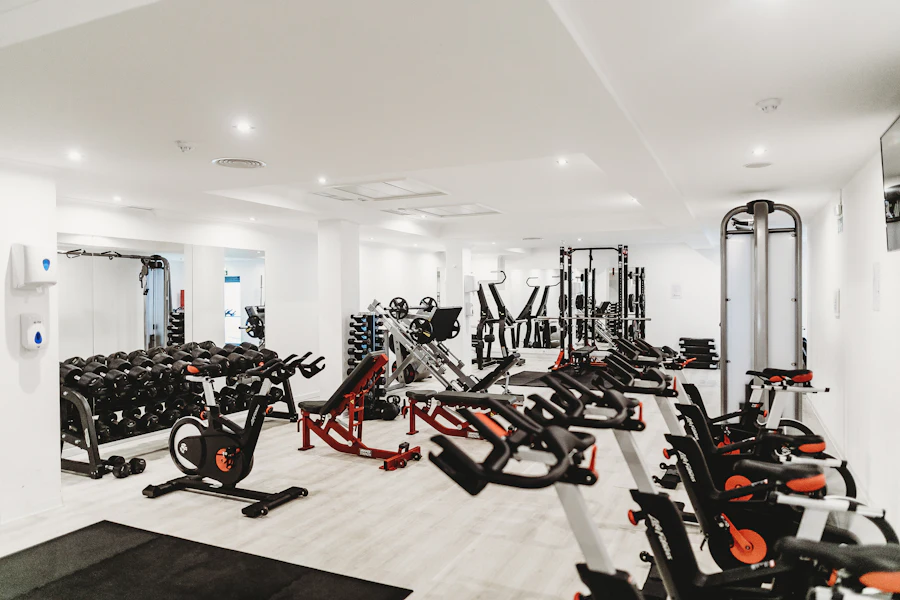
I travel for work about a week a month, and for years the hotel "fitness center" was where my training went to die. You know the room: two treadmills, a single adjustable bench, a rack of dumbbells that stops at 50 lb, and a cable machine nobody has serviced since 2009. Every workout app I owned handed me a program written for a fully-equipped commercial gym, so I'd stand there improvising, do a sad three sets of something, and leave feeling like I'd wasted the trip.
The problem was never the room. It was that I was trying to run a program designed for equipment I didn't have. Once I flipped that — build the session around what's actually in front of me — hotel workouts stopped being a write-off and started being genuinely productive. Here's the framework.
Rule 1: The equipment decides the program, not the other way around
The mistake is walking in with a fixed plan ("today is heavy squats") and then being disappointed the room can't deliver it. Reverse it. Take 30 seconds to inventory what's there — dumbbells and their max weight, a bench, any cable or machine, floor space — and then pick movements that fit. A room with dumbbells up to 50 lb and a bench can run a complete upper/lower session. It just won't be the session you had in your head, and that's fine.
This is exactly the logic behind equipment-aware programming, and it's why I stopped trying to force my home program onto the road. (It's also, full disclosure, the reason I ended up building the gym-scan feature in the app I work on — you photograph the room and it does this inventory-and-match step for you. But you can absolutely do it by hand.)
Rule 2: Intensity techniques replace the weight you don't have
The single biggest hotel-gym anxiety is "the dumbbells are too light." Here's the reassuring part: for hypertrophy, load matters far less than most lifters think, as long as you take sets close to failure. Brad Schoenfeld's research on training to failure and on load has repeatedly shown that lighter weights taken near failure produce muscle growth comparable to heavier weights, provided the effort is there. So when the weight is capped, you buy back the stimulus with technique:
- Higher reps to true proximity-to-failure — take that 50 lb dumbbell set to 15-20 reps with 1-2 reps in reserve.
- Tempo — a 3-second lowering phase on each rep dramatically increases difficulty with no extra weight.
- Mechanical drop sets and rest-pause — bang out reps, rest 15 seconds, go again to extend the set past failure.
- Unilateral work — single-leg and single-arm variations make a light dumbbell feel heavy and add a stability demand.
A 50 lb dumbbell taken to a genuine 18-rep grind with slow tempo is a serious training stimulus. The number on the dumbbell is not the number that matters.
Rule 3: A whole-body session beats a "chest day" on the road
When you only train a few days on a trip, splitting by body part wastes the sessions — you'll never hit everything. The evidence on training frequency (multiple studies summarized by Schoenfeld and colleagues) shows that hitting each muscle group more frequently, at a given weekly volume, is at least as effective as cramming it into one day. On the road, that means full-body every session: one knee-dominant movement (goblet or split squat), one hip-hinge (Romanian deadlift with dumbbells), one push (dumbbell bench or overhead press), one pull (one-arm row), and something for the core. Five movements, 3 sets each, and you've trained your whole body in 40 minutes with a single pair of dumbbells and a bench.
Rule 4: You are maintaining, not maximizing — and that's easy
The last mental shift that helped: a few days in a bad gym is not going to erase months of progress, and you don't need to "make up" for it. The detraining and maintenance literature is genuinely encouraging here — muscle and strength are maintained on far less volume than it takes to build them. A study on maintenance found that a substantially reduced volume preserved strength gains for weeks. So a trip's worth of light, high-effort full-body sessions doesn't just avoid losing ground; it comfortably holds it. Stop treating travel weeks as a threat and they stop being one.
The 20-minute default
When I have no time to think, this is my hotel default, done as a circuit through the whole thing twice:
1. Goblet squat — dumbbell, slow tempo, 15 reps
2. Dumbbell Romanian deadlift — 12-15 reps
3. Dumbbell floor or bench press — to near failure
4. One-arm dumbbell row — 12 per side
5. Plank or hanging/lying leg raise — 45 seconds
Twenty minutes, one pair of dumbbells, done. The gym looked useless. The session wasn't. That's the whole trick: build around the room you're in, push effort where you can't add weight, and stop grieving the barbell you left at home.